Throw pillows are the cheapest way to change a room and the quickest way to wreck one. Five well-chosen pillows can make a plain sofa look collected. Five random ones can make it look like a clearance bin. The difference is rarely taste. It comes down to three things — scale, color, and texture — and most people break the rules without realizing there are any. Here are the mistakes that show up again and again, and how to correct each one.
The most common error is filling a sofa with a floral, a stripe, and a geometric that all read at roughly the same size. Each pillow is fine on its own. Together they buzz. Your eye has nowhere to land, so the whole arrangement looks busy rather than layered.
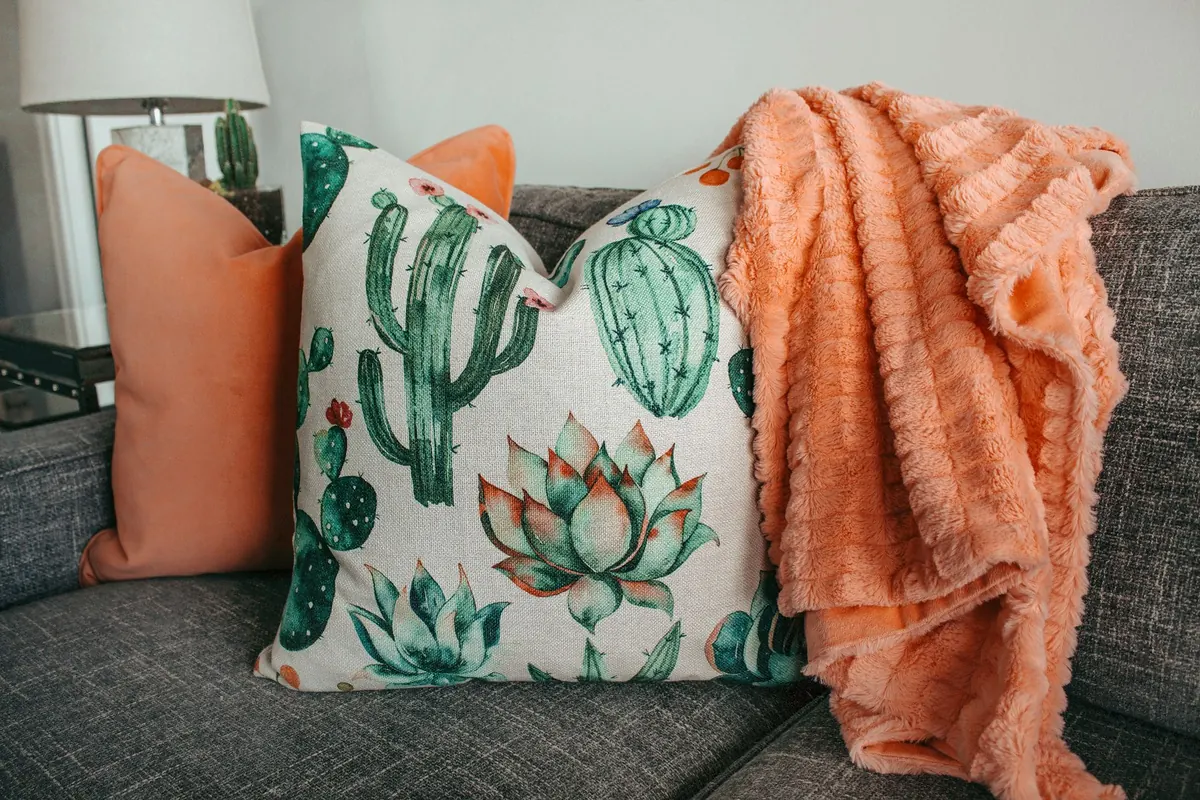
The fix is to assign each pattern a job. Give one pillow the large-scale print — a loose watercolor floral, an oversized ikat, a big painterly stripe. That is your focal point, and there should be only one. Add a medium-scale pattern next: a classic paisley, a medium gingham, a repeating block print. Everything else should be small or solid. A large floral next to a one-inch check looks intentional. The same floral next to a six-inch paisley looks like an accident.
Distance matters here too. From across the room, a tiny ditty print stops reading as a pattern and starts reading as texture, which is genuinely useful. A three-inch print read from ten feet away still reads as a competing pattern. When in doubt, go bigger or go solid.
A second pattern is a second color story, and that is where most arrangements fall apart. If your floral brings in pink, green, and cream, and your stripe brings in navy, rust, and gold, the two pillows are arguing in front of guests.
Pick one multicolor pillow as your source and pull two or three colors from it for everything else. Then divide the space roughly like this:
Solids do not count against your pattern budget. That is the quiet advantage of a plain linen or velvet pillow: it gives the patterned ones room to breathe. Three patterns and no solid is a hard arrangement to pull off. Two patterns and two solids is almost always pleasant.
Two pillows can coordinate perfectly in color and scale and still look flat, because pattern is only two-thirds of the equation. Texture is the third leg, and it is the one people skip.
Think of a sofa with a matched pair of cotton canvas pillows in the same blue-and-white stripe, plus a floral in the same cotton. The colors work. The scale works. The whole thing still feels like a catalog page nobody remembers. Swap one canvas pillow for a nubby wool, a slubby linen, a soft velvet, or a boucle, and the arrangement suddenly has depth.
Photograph your sofa in black and white, or squint at it until the colors blur. If everything turns into the same flat gray shape, you have a texture problem, not a color problem. Look for contrast in weave and sheen: matte wool against shiny velvet, smooth cotton against a rough kilim or an embroidered chain stitch. Two neutrals in the same color family but different fabrics — say, ivory linen and ivory shearling — can carry a whole corner on their own.
Pattern mixing also fails at the layout stage. A row of five pillows of the same size, evenly spaced, reads as a fence. Real arrangements have hierarchy, and hierarchy means size.
Build backward to forward. A 22-inch pillow sits at the back, a 20-inch in the middle, and an 18-inch or a lumbar in front. Odd numbers tend to look more relaxed than pairs, though a matched pair at the back corners of a sofa is a reliable anchor. For a sectional, treat each corner as its own small composition rather than spreading pillows evenly along the whole length. One more practical note: use an insert one size larger than the cover — a 22-inch insert in a 20-inch cover — so the pillow looks full rather than slumped.
Your sofa does not exist alone. The rug, the curtains, the wallpaper, and a large piece of art are all already speaking. Adding three new patterns to a room that already has a busy Persian rug and a striped curtain is how a good idea turns into noise.
Before you buy, count the patterns already in view. If the rug and curtains are both patterned, keep the pillows mostly solid and lean hard on texture. If the room is quiet — plain walls, plain rug, plain sofa — you have room for two or three patterns and should use it. If you are shopping without the room in front of you, bring a photo and a fabric swatch of the sofa, and lay candidate pillows next to each other on the floor before committing.
You do not have to start over. Strip the sofa and rebuild it one pillow at a time, checking after each addition.
Rotate the extras to a bedroom chair or a bench instead of storing them. Most good arrangements come from editing, not buying more.
One large pattern, one medium, the rest small or solid. Two or three colors pulled from a single patterned pillow, with plenty of neutral holding it together. At least one fabric with visible texture, and enough size variation that the arrangement steps forward rather than lining up. Get those four things right and almost any combination of pillows you love will work together — and the ones that do not will be obvious before they ever reach the sofa.
Photo: Designecologist / Pexels